The word “insight” reigns supreme in therapeutic environments. It connotes an “ah ha” moment and deep, perhaps new, understanding. “Knowledge,” however, receives less attention. The word may actually carry an unfair burden because therapists tend to subordinate “knowing” to “feeling.” Interestingly, “feeling” often connotes a strange kind of knowledge, one present in the idiomatic expression, “I know it, but I don’t know it, you know?” Here, knowing means feeling, internalizing, acting upon. Thus, while I might know (cognitively) that I am a good person, I don’t yet know (feel, believe) it, as is evident through sheepish and/or self-defeating behaviors. The work of the therapist seems to be to attend to the client as he/she/they forms insight, such that the client, fully supported by the therapist, comes first to understand the difference between knowing and knowing, and then acts effortlessly in life such that the knowing bodies forth through behavior. But what does this therapeutic attendance look like? Once supported, how exactly does the client reframe knowledge such that it ceases to be remanded to the field of useless cognition and transmutes itself into the realm of useful belief and behavior? The answers to those questions pass through the terrain of insight, but they require understanding “knowledge” in a more precise way.
The two 20th-Century French philosophers whose work helped me refine my understanding of knowledge are Michel Foucault and Gilles Deleuze. The latter, writing about the former, explains that knowledge occurs by bridging two realms, the visible (i.e., the seeable) and the articulable (i.e., the sayable). For Foucault, knowledge does not exist until that which is visible unites with that which is sayable. And this union is no easy feat because each domain is governed by its own rhythms. Artworks provide clear examples of these different rhythms at work.
The two 20th-Century French philosophers whose work helped me refine my understanding of knowledge are Michel Foucault and Gilles Deleuze. The latter, writing about the former, explains that knowledge occurs by bridging two realms, the visible (i.e., the seeable) and the articulable (i.e., the sayable). For Foucault, knowledge does not exist until that which is visible unites with that which is sayable. And this union is no easy feat because each domain is governed by its own rhythms. Artworks provide clear examples of these different rhythms at work.
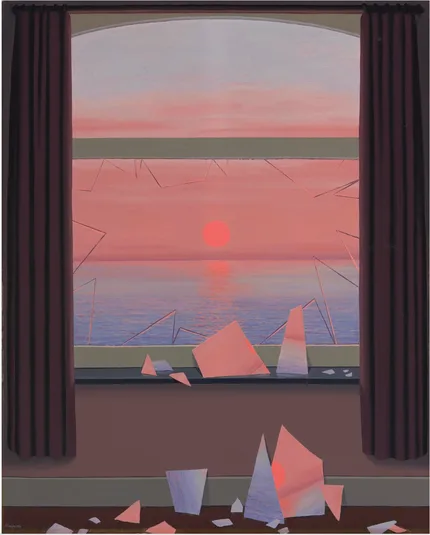
René Magritte, Les monde des images (1950)
I hung a print of this Magritte painting in my office for a while and I used it as a diagnostic tool. I was curious about which clients noticed it, commented on it, questioned it, and attempted to analyze it. Fewer than half of my clients acknowledged it at all. Those who looked at it for more than a few seconds said nothing about it. The small number of people who spoke about it were divided into two unequal categories. The first group, larger in number, made superficial comments, such as “That’s a cool picture.” The second group, including maybe 2 or 3 clients total, produced questions like, “What’s going on with that?” If people said anything about the painting at all, I would ask a series of questions. “Tell me, what do you see?” “What do you make of the broken glass?” “The title is ‘World of Images,’ why do you think it’s called that?” Exactly 0 clients ventured in-depth answers to those questions, and the same number arrived at anything resembling an analysis of the picture. As such, there was no knowledge produced during their engagement with the image. That is, the realms of the visible and the articulable were not bridged.
Not bridging the two realms took a tremendous amount of restraint on my part because the painting produces knowledge that is, in 100% of cases, relevant to people engaged in therapeutic work. The gestalt of the scene conveys a familiar experience, one that some people may even describe as beautiful or calming: A sun setting or rising over/from the ocean horizon. The familiar starts to become strange when one notices that the view of the sun is framed by a broken window. A little bit of thinking leads to the realization that the presence of shards of glass inside the room suggests the window broke inward, i.e., something from outside broke the window. But this logical line of thought breaks, too, since the shards of glass reveal an uncanny detail. The shards are not transparent pieces of glass. They seem to have retained the image of the setting/rising sun. Interestingly, the journey of the eye across the canvas leads from the center of the sun down towards the shards of glass, and if the eye keeps moving in that direction it will leave the canvas and encounter the caption that holds the painting’s title: The World of Images. Magritte has provided the domain of the seeable (the painting) and the domain of the sayable (the painting’s title) but has not bridged the two. The bridging, which I’ll call thinking, is the work required to produce knowledge of the painting. Clients in therapy benefit from undertaking precisely this work—both of this painting in particular and of knowledge production generally—because the strangeness of “the world of images” is usually one of the distressing aspects of daily life that brings them into therapy in the first place.
The work required is not that of making the normal (sunset/sunrise) strange (as seen felt in the view of the shards retaining that which was seen through the window), but, rather, of acknowledging the strangeness of the “world of images” and the work of knowledge production typically glossed over by habitual actions (such as, for example, the act of looking). The world outside the room is a world of dynamic forces. The forces seem to have broken inward through the glass. More than that, the image of the sun has burned itself upon the glass, much like light impresses itself upon the film in the production of photographic images. But when the eye returns to the plane dividing the interior and the exterior of the painted room, it returns with a worry. On what now are the forces of the world impressing themselves? My eyes? Who’s to say they won’t burn and break my eyes? Of course, that’s not possible because none of this is as it seems. This is a painting. The force of my seeing is producing each and every “fact” of the painting in front of me. I see broken glass, but there is no real broken glass. I see an impossibility in the form of a scene of the world imprinted upon glass that once framed the same scene of the world, but there is no impossibility here since there is no “real world,” only an image of it. The force of my looking is meeting the force of the The World of Images pressing in against my eyes. My awareness of this illuminates the materiality of my encounter with the painting, which is to say the materiality of thought. Or, as Magritte said in a letter to Foucault, “thought is what sees and can be described visibly” (cited in Deleuze, Foucault, 49). In a beautiful touch, Magritte frames his window with curtains that are reminiscent of those we might see framing a proscenium stage in a theatre. We have here a pictorial dramatization of the theatrical performance of seeing and being seen.
The theatre event replays itself on a daily basis in a profoundly mundane fashion. I believe that some external force is producing distress in my life. The distress is akin to the burning force of the sun that shatters the glass, throws shards inwards toward my intrapsychic fortress of solitude, and produces a disturbing, nightmarish wrinkle in the fabric of my daily life. As Epictetus pointed out millennia ago, however, it's not things that upset us, but our judgments about things. The supposedly external circumstances that bother me are known entirely through how I see and interpret them. The change one seeks will rarely take place in the world “outside;” rather, it will take place through a process of seeing differently. To return to Deleuze and Foucault, how I say and thus define what a problem is will change once I see the so-called “problem” in a new way. The knowledge of a “problem” is always multifaceted, and yet we typically hold ourselves in one position and continue to appraise the problem from a single degree of perspective instead of circling the problem to encounter the other 359-degrees.
Not bridging the two realms took a tremendous amount of restraint on my part because the painting produces knowledge that is, in 100% of cases, relevant to people engaged in therapeutic work. The gestalt of the scene conveys a familiar experience, one that some people may even describe as beautiful or calming: A sun setting or rising over/from the ocean horizon. The familiar starts to become strange when one notices that the view of the sun is framed by a broken window. A little bit of thinking leads to the realization that the presence of shards of glass inside the room suggests the window broke inward, i.e., something from outside broke the window. But this logical line of thought breaks, too, since the shards of glass reveal an uncanny detail. The shards are not transparent pieces of glass. They seem to have retained the image of the setting/rising sun. Interestingly, the journey of the eye across the canvas leads from the center of the sun down towards the shards of glass, and if the eye keeps moving in that direction it will leave the canvas and encounter the caption that holds the painting’s title: The World of Images. Magritte has provided the domain of the seeable (the painting) and the domain of the sayable (the painting’s title) but has not bridged the two. The bridging, which I’ll call thinking, is the work required to produce knowledge of the painting. Clients in therapy benefit from undertaking precisely this work—both of this painting in particular and of knowledge production generally—because the strangeness of “the world of images” is usually one of the distressing aspects of daily life that brings them into therapy in the first place.
The work required is not that of making the normal (sunset/sunrise) strange (as seen felt in the view of the shards retaining that which was seen through the window), but, rather, of acknowledging the strangeness of the “world of images” and the work of knowledge production typically glossed over by habitual actions (such as, for example, the act of looking). The world outside the room is a world of dynamic forces. The forces seem to have broken inward through the glass. More than that, the image of the sun has burned itself upon the glass, much like light impresses itself upon the film in the production of photographic images. But when the eye returns to the plane dividing the interior and the exterior of the painted room, it returns with a worry. On what now are the forces of the world impressing themselves? My eyes? Who’s to say they won’t burn and break my eyes? Of course, that’s not possible because none of this is as it seems. This is a painting. The force of my seeing is producing each and every “fact” of the painting in front of me. I see broken glass, but there is no real broken glass. I see an impossibility in the form of a scene of the world imprinted upon glass that once framed the same scene of the world, but there is no impossibility here since there is no “real world,” only an image of it. The force of my looking is meeting the force of the The World of Images pressing in against my eyes. My awareness of this illuminates the materiality of my encounter with the painting, which is to say the materiality of thought. Or, as Magritte said in a letter to Foucault, “thought is what sees and can be described visibly” (cited in Deleuze, Foucault, 49). In a beautiful touch, Magritte frames his window with curtains that are reminiscent of those we might see framing a proscenium stage in a theatre. We have here a pictorial dramatization of the theatrical performance of seeing and being seen.
The theatre event replays itself on a daily basis in a profoundly mundane fashion. I believe that some external force is producing distress in my life. The distress is akin to the burning force of the sun that shatters the glass, throws shards inwards toward my intrapsychic fortress of solitude, and produces a disturbing, nightmarish wrinkle in the fabric of my daily life. As Epictetus pointed out millennia ago, however, it's not things that upset us, but our judgments about things. The supposedly external circumstances that bother me are known entirely through how I see and interpret them. The change one seeks will rarely take place in the world “outside;” rather, it will take place through a process of seeing differently. To return to Deleuze and Foucault, how I say and thus define what a problem is will change once I see the so-called “problem” in a new way. The knowledge of a “problem” is always multifaceted, and yet we typically hold ourselves in one position and continue to appraise the problem from a single degree of perspective instead of circling the problem to encounter the other 359-degrees.